
The move is being considered after growing clamour from competing 4G operators for a level playing field in relation to Qualcomm.

The reference will also seek the court's view on a more fundamental issue: whether the judgement lays down auction as mandatory for allocation of all natural resources across all sectors and in all circumstances.
The Department of Telecommunications (DoT) is working on various alternatives to overcome the hurdles arising out of a lacklustre auction of 1,800-MHz telecom spectrum.

The court issued notices to the Law Ministry and the DoT, rejecting their contentions that the same cannot be issued against them as they were not the parties to the case.

According to sources, DoT has been asked to prepare a matrix of various levels of reserve price and spectrum usage charge at every Rs 1,000 crore (Rs 10 billion) difference in descending order and the impact that would have on tariffs for end-consumer and the revenue accrued to the government.

A draft report of the Public Accounts Committee of Parliament has expressed shock that Department of Telecommunication has no monitoring mechanism to verify authenticity of the self-certification of the operators, deprecating "such a mindless arrangement made by the DoT to check the radiation level."


The regulator has also agreed to the one-nation, one-licence proposal, which will make roaming free across the country. But it wants to decide the modalities of the issue.

The ministry wanted to use spectrum in the 700-MHz band for mobile TV services.
The government on Friday gave its analysis of the Supreme Court's 2G judgments saying it "travelled beyond" the established limits of judicial review and entered the exclusive domain of the executive when it held that the policy of first-come-first-served was flawed.

It will also file a review petition on Friday, which, while not challenging the cancellation of licences, will seek a reconsideration of the court's declaration.
The Department of Telecommunications is planning to give more powers to the telecom regulator, Telecom Regulatory Authority of India, in the new telecom policy, including the power to impose financial penalties on the erring telecom service providers.

So far 2,06,024 pensioners have submitted DLCs.

Prime Minister Manmohan Singh on Thursday said a strong domestic manufacturing base in electronics and telecommunications will mitigate burden of growing imports for the sector.

In a move that could pave the way for open auction of the 2G spectrum released from 122 cancelled operators, a draft Cabinet note prepared by the Department of Telecommunications (DoT) has recommended the spectrum price be discovered through an auction involving "existing players and new parties".

The auction of 2G spectrum might be delayed, as the government may file a petition in the Supreme Court for an extension of the timeline. According to current SC directive, the auction has to be conducted by August 31 this year. However, due to procedural delays, the department of telecommunications is looking at extending the timeline.
Following is the chronology of events in the 2G scam.

The Department of Telecommunications (DoT) expects to finalise the norms for mergers and acquisitions and spectrum sharing by the end of June. It also plans to approve the National Telecom Policy (NTP), 2012, by the end of July.

Tharoor put the blame for the logjam in Parliament on BJP and accused the saffron party of reducing the "temple of democracy to a rubber stamp for its agenda or worse, a notice board to announce its unilateral decisions".

In May, Trai had gave its recommendations on a 'Spectrum Management and Licencing Framework', in which it had said that consequent to the merger of licences in a service area, the total spectrum held by the resultant entity post-merger shall not exceed 12.4 MHz for GSM technology, or 10 MHz in case of CDMA technology.

Local residents and even security personnel are using Nepalese SIM cards in border areas of Uttarakhand as no state-owned or private telecom company from India is providing services in the area, raising security issues.

The recommendations on the subject will be sent in due course to the government, according to an internal communication of DoT

The empowered group of ministers, headed by P Chidambaram (who has now taken over as the Finance Minister) has suggested a 20 per cent lower base or reserve price at Rs 14,000-15,000 crore (Rs 140-150 billion) for 5 Mhz of airwaves as against around Rs 18,000 crore (Rs 180 billion) recommended by sectoral regulator Trai for the auction of spectrum vacated after the Supreme Court order.

This will enable security agencies to tap any call, real-time chat and data without help from the operators.
The department of telecommunications has referred the issue of using multiple technologies under a single unified access services licence to the Telecom Regulatory Authority of India.

DoT has stated in an internal note that the 3G roaming agreements between these three companies are tantamount to their becoming mobile virtual network operators, something not allowed under the current policy.
Historically, public sector units were conceived of under the assumption that they will control the 'commanding heights' of the Indian economy, which were necessary for rapid industrial growth but where private investment was unwilling to enter.
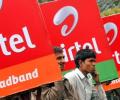
Airtel, Vodafone-Idea and other telecom operators may have to pay the government a whopping Rs 1.42 lakh crore following the Supreme Court order last week that sent shock waves through an industry already grappling with billions of dollars in debt and an intense tariff war to retain customers.

A senior official from the department of telecommunications (DoT) confirmed that Telcordia has been given 'conditional clearance' by the ministry of home affairs and MNP will be launched on January 20.

The Department of Telecommunications (DoT) has asked the Telecom Regulatory Authority of India (Trai) to indicate the formula used in international markets to fix the ratio between the reserve and the discovered prices of 2G telecom spectrum. Trai has assumed that the base price should be 80 per cent of that of the auction discovered price which is much higher than the internatioanl norm of 50 per cent.

The government had set August 15 as the deadline for Canada's Research In Motion to provide the country's security agencies with the interception keys to enable real-time tracking of its popular BlackBerry messenger and corporate email services in readable format.

To speed up the vacation of additional 2G and 3G telecom spectrum, the government will likely make a Rs 5,000-crore (Rs 50 billion) provision in the Budget for an alternative network for defence services. The spectrum released in lieu of that would increase the availability for civilian use.

Companies like Amazon Prime Video are also temporarily lowering bit rates -- a measure of how much data is being transferred -- to ease pressure on telecom network infrastructure.

Firms to pay Rs 24,700 cr if spectrum formula is accepted.

A panel led by the secretaries of the DEA and the DIPP would conduct a quarterly review on the pending proposals.

Earlier, the Telecom Commission, a decision-making arm of the Telecom Ministry, had recommended that the government pick up a majority stake in the special purpose vehicle created to execute the sale of surplus land lying with VSNL (now Tata Communications).

Amid the opposition UDF's sloganeering against him, Kerala Governor Arif Mohammed Khan on Friday delivered the customary address to the assembly with the policy document outlining the Left government's administrative achievements and criticising the Centre for allegedly pushing the state to financial constraints by reducing its resource allocations.
Says Airtel-Vodafone-Idea pacts violate licence terms; firms may move TDSAT.
